
At sea, there is no room for the failure of marine cables. A single compromised cable can silence a navigation system, stall a generator, or leave a vessel dark in the middle of the ocean—which is exactly why marine cable is not just another component but the nervous system of every ship afloat.
At Jaspore, one of Asia’s leading marine cable suppliers headquartered in Singapore, with stocking hubs across Malaysia, Hong Kong, and China’s major ports, we understand that the cable behind the bulkhead carries more than current—it carries the safety of every crew member onboard and the uptime of every voyage you commit to. This article will help you understand the exact marine cable manufacturing process, and this guide walks you through exactly how marine cables are manufactured, from raw copper to the finished drum, so you can make procurement decisions with the confidence they deserve.
Why Marine Cables Demand a Higher Standard
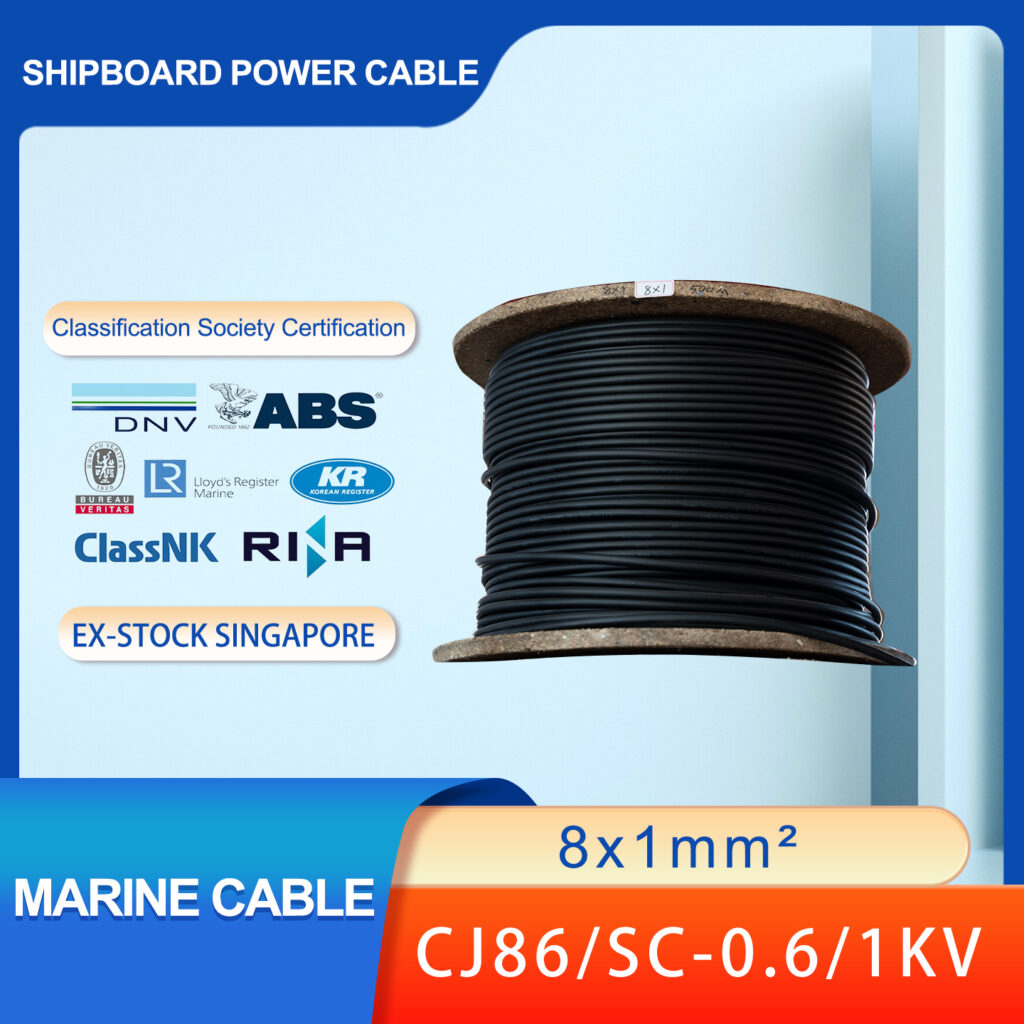
Ordinary industrial cable is engineered for a controlled environment. Marine cable has no such luxury. It must withstand relentless saltwater exposure, oil contamination, extreme temperature swings, UV degradation, constant vibration, and corrosive salt-laden air—often for decades, without the option of an easy replacement mid-voyage. That is why every stage of marine cable manufacturing is held to the world’s most demanding classification standards, including IEC, KR, NK, DNV, Lloyd’s Register, ABS, CCS, and BV. Each certification is not a formality; it is a promise that the cable will perform when everything else on board depends on it.
So let’s dive into each key point of the marine cables manufacturing and the function it plays.
Step 1: Material Selection—The Foundation of Superior Marine Cables
Every reliable marine cable begins with uncompromising material choices, because a weak link at this stage cannot be corrected later.
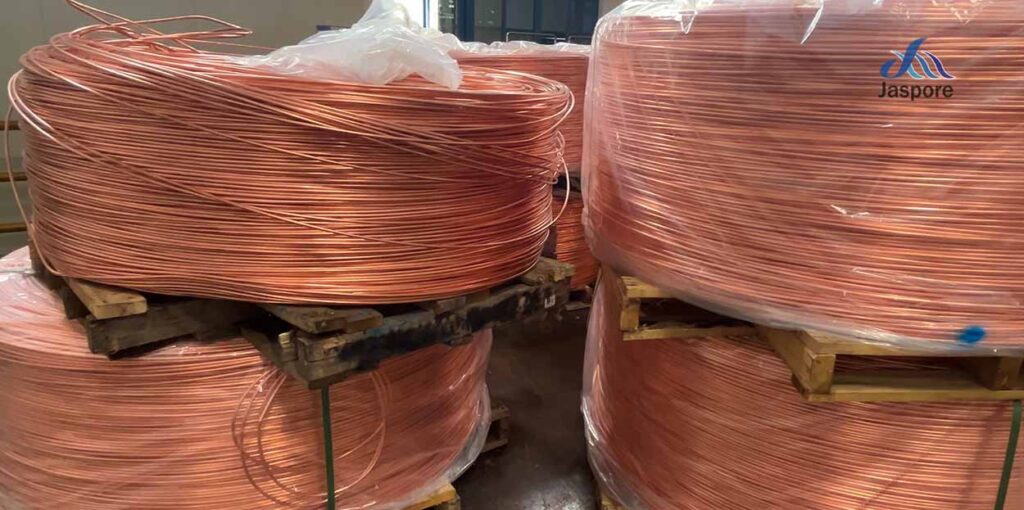
- Conductor: High-purity oxygen-free copper (OFC) forms the core, prized for its exceptional conductivity and its resistance to the corrosive marine atmosphere.
- Insulation: PVC, Cross-Linked Polyethylene (XLPE), and Ethylene Propylene Rubber (EPR) are selected for their electrical integrity, thermal endurance, and chemical resilience.
- Sheathing: An outer layer of PVC or polyurethane (PU) shields the cable from water ingress, oil exposure, UV breakdown, and mechanical impact.
- Shielding: Copper braid or aluminum foil blocks electromagnetic interference, safeguarding the navigation and communication systems a crew’s safety depends on.
Step 2: Conductor Manufacturing—Precision From the First Pull
The conductor is the electrical heart of the cable, and it is built with a precision that leaves no margin for error.
- Wire Drawing: Copper rods are drawn through high-speed machines to an exact diameter, with tightly controlled speed and lubrication ensuring a flawless, defect-free surface.
- Stranding & Annealing: Individual wires are helically stranded at calculated lay lengths for flexibility and tensile strength, then annealed to relieve internal stress—a step that proves its worth every time the cable flexes under the constant vibration of life at sea.
Step 3: Insulation Extrusion—Protecting Every Core
A single void in the insulation can compromise the entire cable, so this stage tolerates no shortcuts.
- Preheating: Conductors are preheated to guarantee perfect adhesion of the insulation compound.
- Extrusion: Advanced extruders apply insulation evenly around each conductor under exacting temperature, pressure, and speed controls, eliminating bubbles, contaminants, and thickness variation before they can ever become a fault at sea.
- Cooling: Rapid water or air cooling immediately solidifies the insulation, locking in its mechanical strength and dielectric performance for the long haul.
Step 4: Shielding—EMI Protection for Mission-Critical Systems
Modern vessels run on sophisticated navigation, automation, and communication systems—and none of them can function if the signal is corrupted.
There are two main types of shielding in the market:
- Copper Braid Shielding: Copper wires are braided tightly over the insulated cores to a specified coverage density, delivering dependable EMI protection.
- Aluminium Foil Shielding: Often paired with copper braid, this longitudinally wrapped foil forms a continuous barrier that keeps signal integrity intact—a necessity on today’s smart ships.
Step 5: Outer Sheath Extrusion—The Cable’s First Line of Defense
The outer sheath stands directly between your electrical system and the harshest environment on earth. Its extrusion mirrors the insulation process, but the compound must be matched precisely to where the cable will live—engine room, weather deck, cargo hold, or offshore platform. The result is a jacket engineered to resist water, oil, fuel, chemicals, fire, and physical abrasion, voyage after voyage.
Step 6: Cabling—Engineering Structural Integrity
Multi-core cables must become one unified, structurally sound assembly, not a bundle of separate parts.
- Core Arrangement: Cores are arranged in concentric or sector configurations to meet exact design standards.
- Stranding: Cores are stranded together at precise lay lengths under controlled tension for a stable, compact structure.
- Filling: Filler materials such as polypropylene rope or rubber are added to achieve a perfectly round profile, strengthening the cable and easing installation.
Step 7: Rigorous Testing — Zero Compromise on Quality
Before any marine cable leaves our supply chain, it must prove itself under conditions that mirror the ones it will face at sea.
- Electrical Testing: Insulation resistance, high-voltage withstand (dielectric strength), and conductor DC resistance.
- Mechanical Testing: Tensile strength, flexibility, and abrasion resistance.
- Environmental Testing: Water resistance, oil immersion, flame retardancy, and high-temperature performance.
- Shielding Performance Testing: EMI attenuation verification for complete electromagnetic compatibility.
Every test is conducted to international classification society requirements so that ship owners and ship management companies can trust every single meter of cable we deliver.
Step 8: Packaging & Global Delivery — From Our Warehouses to Your Destination
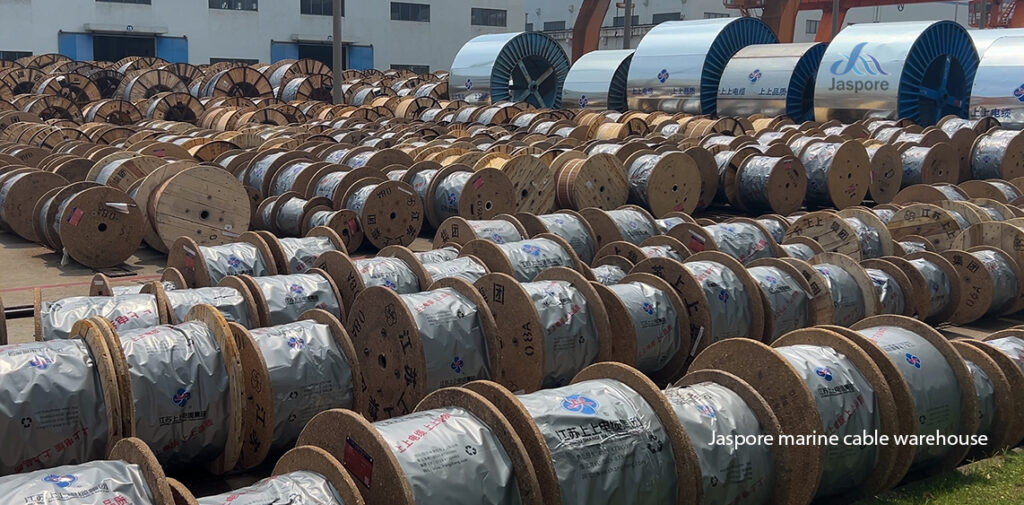
Once tested and approved, each cable is wound onto timber or steel drums and clearly marked with type, specification, drum length, and batch number—nothing left to guesswork. With stock hubs strategically placed across Singapore, Malaysia, and China’s major ports, Jaspore is positioned to deliver to any port or shipyard in the world, fast, efficiently, and without excuses.
Why Ship Owners & Shipping Companies Choose Jaspore.
✅ All Types of Marine Cables in Stock—No waiting. No sourcing delays.
✅ Singapore-Based, Globally Connected—Stocking locations across Singapore, Malaysia, Hong Kong & China’s main ports.
✅ Delivery to Any Port or Shipyard Worldwide—We go where your vessels go.
✅ Trusted by World-Class Shipping Companies & Ship Management Companies — Decades of expertise serving the global maritime industry.
✅ Full Compliance—DNV, LR, ABS, BV, IEC, KR, CCS, and NK certified cables available.
✅ Expert Technical Support — Our team speaks your language, whether it’s cable specifications, classification requirements, or urgent vessel supply needs.
Ready to Source Marine Cables? Contact Jaspore Today
Whether you’re a ship owner managing a global fleet, a shipping company racing a tight drydock schedule, or a ship management company searching for a marine cable supplier you can rely on for the long term—Jaspore has the stock, the expertise, and the logistics network to keep your vessels moving.