
Looking for a reliable marine cable supplier in Singapore or across Asia-Pacific? Before you place your next order, make sure you actually understand what you’re buying. If you’ve ever stared at a marine cable label like that CJ86/SC-0.6/1kV and had no idea what it means, you’re not alone. As a marine cable supplier working with shipyards, vessel operators, and procurement teams across Asia and beyond, I get this question all the time. So let me break it down for you—straight, no fluff.
Whether you’re sourcing marine cable in Singapore, replacing cables on a vessel in dry dock, comparing quotes from different marine cable vendors, or just trying to make sure you’re ordering the right spec from your marine cable supplier—this guide is for you. Bookmark it. Share it with your team. You’ll use it again.
Why Understanding Marine Cable Codes Matters
Ordering the wrong marine cable isn’t just a procurement headache—it’s a safety risk. The wrong insulation material, missing flame retardancy rating, or incorrect armor type can fail classification surveys and, worse, put crew lives at risk.
As a marine cable vendor with stock in Qingdao, Zhoushan, Guangzhou, and Singapore, I’ve seen too many orders go wrong because someone didn’t know what the letters meant. This guide fixes that.
The Structure of a Marine Cable Code
Every marine cable code is built left to right, with each segment telling you something specific:
CJ86/SC-0.6/1kV
| Position | Segment | What It Tells You |
|---|---|---|
| 1 | Series Type | What the cable is used for |
| 2 | Insulation Code | What insulates the conductors |
| 3 | Armour Code | How the cable is mechanically protected |
| 4 | Outer Sheath Code | The outermost protective layer |
| 5 | Flammability Code | Fire and smoke performance |
| — | Voltage / Size | Electrical rating or conductor configuration |
Let’s go through each one.
1. Series Type—What Is This Cable For?
This is the first thing I check when a customer sends me a cable code. The series type tells you the cable’s role on board.
| Code | Meaning | Application |
|---|---|---|
| CK | Shipboard Control Cable | Control circuits, automation systems |
| CH | Shipboard Telecommunication & Signal Cable | Navigation, comms, signal lines |
| CB | Shipboard Insulated Wire | General wiring inside equipment |
| C | Shipboard Power Cable | Main power distribution |
Pro tip: Always read double-letter codes (CK, CH, CB) as a pair first. A lone C means power cable, but CH means telecom—a completely different cable, a completely different application.
2. Insulation Code—What’s Around the Conductors?
The insulation material directly affects the cable’s performance in heat, moisture, and chemical exposure—all real concerns on any vessel.
| Code | Material | Notes |
|---|---|---|
| E | EPR (Ethylene Propylene Rubber) | Excellent for flexibility and heat resistance |
| J | XLPE (Cross-Linked Polyethylene) | High electrical performance, ideal for power cables |
| V | PVC | Cost-effective, lower temperature rating |
| Y | PE (Polyethylene) | Good for signal cables |
For most marine cable applications, E and J are the go-to insulation types. If a customer asks me for a reliable marine cable supplier recommendation, I always steer them toward EPR or XLPE-insulated cables for critical systems.
3. Sheath Code—The Outer Protection Layer
The sheath is what stands between your cable and the harsh marine environment—saltwater spray, oil, UV exposure, and mechanical wear. This is where LSOH (Low Smoke, Zero Halogen) compliance becomes critical.
| Code | Material | Standard |
|---|---|---|
| PJ | LSOH Cross-Linked PO Sheath | SHF2 |
| PF | LSOH Non-Cross-Linked PO Sheath | SHF1 |
| H | CSPE (Chlorosulphonated Polyethylene) | SH |
| F | CR (Chloroprene Rubber) | SE1 |
| V | PVC | — |
In enclosed ship spaces, LSOH matters enormously. If a fire breaks out, PVC sheaths release toxic halogen gases that can incapacitate crew before they even reach the fire. PJ and PF sheaths are the modern standard—and any reputable marine cable supplier in Singapore or globally should be stocking these as their primary range.
4. Armour Code — Mechanical Protection
Numbers in the code tell you how the cable is armoured and what the outer finish looks like.
| Code | Meaning |
|---|---|
| 8 | Tinned Copper Wire Braid (TCWB)—also shields against EMI |
| 9 | Galvanized Steel Wire Braid (GSWB)—heavy mechanical protection |
| 0 | No outer sheath |
| 2 | PVC outer sheath |
| 5 | Cross-linked PO outer sheath |
| 6 | Non-cross-linked PO outer sheath |
Tinned copper braid (8) is the most common armor type I supply. It does double duty—mechanical protection and electromagnetic shielding. For signal and telecom cables especially, EMI shielding is non-negotiable.
5. Structure Code — Special Construction Details
| Code | Meaning |
|---|---|
| P | Individually screened (each core shielded separately) |
| R | Flexible, Class 5 fine-stranded conductor |
P is critical for multi-core signal cables where crosstalk between cores would corrupt data. R is what you want in high-vibration areas or anywhere the cable needs to flex regularly.
6. Flammability Code — Fire Performance Rating
This is the code segment that classification societies care about most. Don’t cut corners here.
| Code | Meaning | Standard |
|---|---|---|
| S | Bunched Flame Retardant | IEC 60332-3 |
| D | Single Cable Flame Retardant | IEC 60332-1 |
| N | Fire Resistant / Fire Proof | — |
| C | Low-smoke, halogen-free, low toxicity | — |
| A | Produces smoke, halogen, and toxic gases | Legacy type |
Modern marine standards strongly prefer S or C codes. A type of cable is being phased out in new marine cable installations. If you’re doing a new build or refit and a vendor is still pushing A-type cables, find a better marine cable vendor.
Real-World Examples: Reading the Code Like a Pro
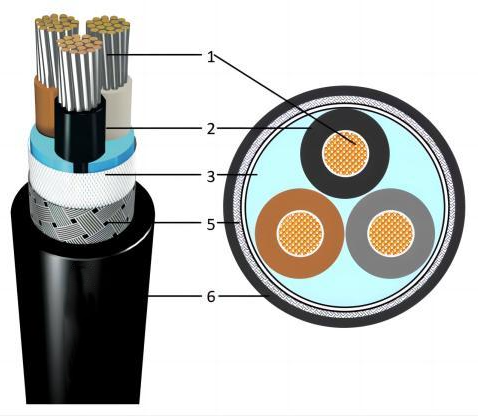
Example 1: CJ86/SC-0.6/1kV — Shipboard Power Cable
| Segment | Code | Meaning |
|---|---|---|
| Series | C | Shipboard Power Cable |
| Insulation | J | XLPE insulation |
| Armour | 8 | Tinned Copper Wire Braid |
| Outer Sheath | 6 | Non-cross-linked PO outer sheath |
| Flammability | S | Bunched Flame Retardant |
| Smoke/Toxicity | C | Low-smoke, halogen-free, low toxicity |
| Voltage | 0.6/1 kV | 0.6/1 kilovolt rating |
What this cable does: Carries power on board with XLPE insulation and tinned copper braid armor, fully LSOH compliant and bunched flame retardant rated. This is a workhorse cable you’ll find on vessels all over the world.
Example 2: Shipboard Telecom & Signal Cable
| Segment | Code | Meaning |
|---|---|---|
| Series | CH | Shipboard Telecommunication & Signal Cable |
| Insulation | J | XLPE insulation |
| Armour | 8 | Tinned Copper Wire Braid |
| Outer Sheath | 6 | Non-cross-linked PO outer sheath |
| Flammability | S | Bunched Flame Retardant |
| Smoke/Toxicity | C | Low-smoke, halogen-free, low toxicity |
| Configuration | 2×2×0.75 | 2 pairs, 2 cores each, 0.75 mm² conductor |
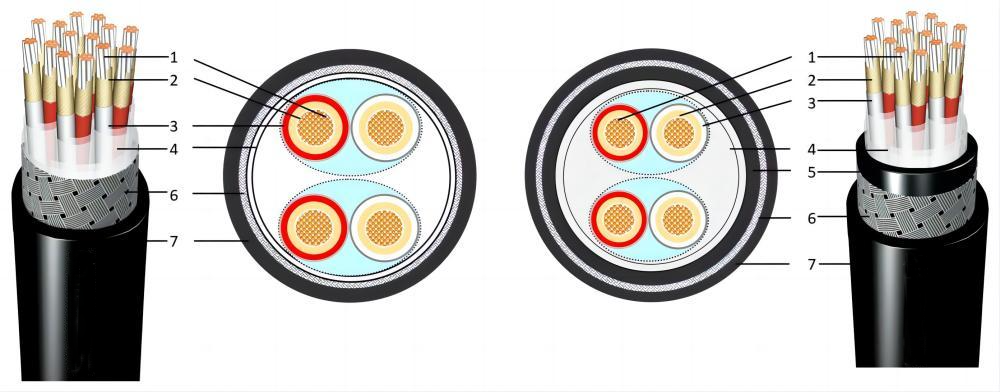
What this cable does: Handles communication and signal transmission on board—navigation systems, alarms, and control signals. The 2×2×0.75 configuration means 2 twisted pairs, each pair having 2 cores of 0.75 mm² conductor.
What to Check When Sourcing Marine Cable
As a marine cable supplier, here’s my practical checklist for procurement:
- ✅ LSOH compliance—look for PJ or PF sheath codes
- ✅ EMI shielding—look for armor code 8 or structure code P
- ✅ Flame retardancy—look for flammability code S for bundled runs
- ✅ Correct voltage class—match to your system requirements
- ✅ Classification approval—confirm DNV, ABS, Lloyd’s, BV, KR, Class NK, CCS, or relevant society approval
- ✅ Stock availability—a good marine cable vendor should have stock ready, not lead times of months
If you’re sourcing marine cable in Singapore or anywhere in the Asia-Pacific, make sure your supplier can answer all of the above without hesitation.
For more issues and questions, please feel free to contact us by WhatsApp.